
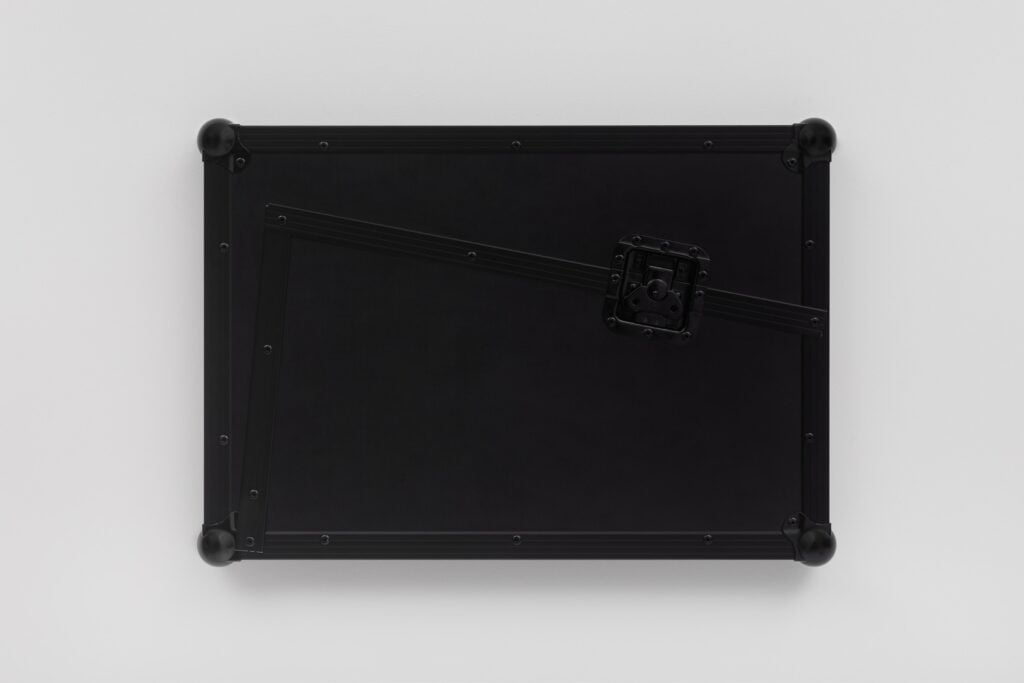
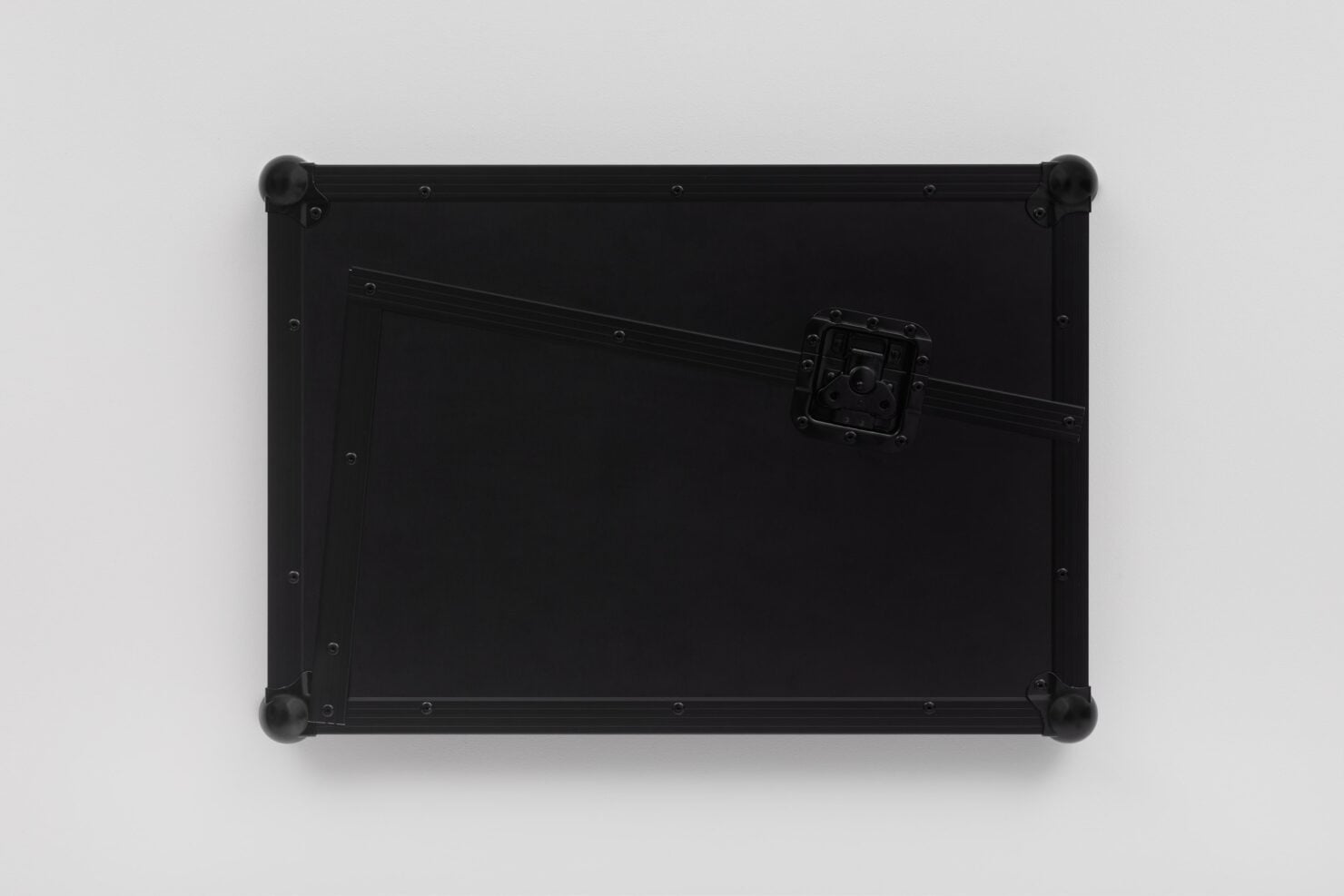
Phenol 1, 2026. Phonelic resin board, aluminum extrusions, recessed spring-loaded aluminum handles, steel hardware, blind rivets. 47,5 x 67 x 6 cm / unique
A Case for Cugly
Flight cases are the standardized workhorses of the culture industry, designed to be visually inconspicuous, highly functional carriers of delicate, specialized equipment. They spend their lives on the margins (in transit, stacked backstage or in storage areas) and rarely, if ever, take centre stage. In Niet Pistol Blind at Christian Torp, the Oslo-based, American artist Agatha Wara puts them on display, transforming them into attractive wall-hung objects somewhere between industrially produced 1960s minimalist sculpture and Ad Reinhardt’s black paintings. Their surfaces – powdery, satin-finished black, and in some instances a shiny white – are framed and bisected by aluminium and festooned with handles and latches that no longer serve any clear purpose. Stillness and display are a strange fate for an object ordinarily built to keep things moving, and it suggests that the work’s real subject is the how and why of circulation – not only within contemporary art, but across culture at large.
Keeping things moving has become a fixation in recent English-language art writing, much of which has focused on the difficulties of sustaining a career as an artist in the long term, and by extension, on changes in the ways in which artworks and artists circulate globally. Just this past March, artist Josh Kline’s essay on the futility of trying to produce work in New York against the backdrop of ever-rising real estate prices and the cost-of-living crisis, published in the ordinarily scholarly journal October, was everywhere: forwarded to colleagues by email, lauded and picked apart on Instagram, rebutted in Hyperallergic and written up, of all places, in the New York real-estate press.[1] Further afield, in journals and newspapers in cities such as Copenhagen, Oslo, Rome and London, critics were eager to measure Kline’s pessimistic diagnosis of the art circuit’s deep-seated economic issues against ongoing gentrification, inflation, and cuts to public funding and grant schemes – all knock-on effects of more than a decade of austerity, and a general turn towards the right in global politics. Mobility – meaning the ability of contemporary art to circulate globally – suddenly seemed like less of a given.
Among the ballooning costs Kline lists, alongside maintaining a studio and the clothes, drugs and bar-and-dinner schedule required to stay socially relevant in New York, is art storage – “real estate again”, as he puts it in a terse parenthesis – now so expensive that galleries, collectors and even museums are steering clear of acquiring sculpture altogether. Kline points out that this in turn incentivizes artists to produce certain kinds of work (i.e. painting) which is easy to store, circulate and ship, with no complicated on-site assembly required.[2] Which brings us back to Wara’s flight cases. Ordinarily, a flight case would ship amps, mixing desks and lighting rigs, or camera equipment across continents and from venue to venue, so that concerts, stand-up tours and film shoots can take place in a standardized manner. Turned into artworks, they suggest two things at once: that art, too, is a sort of standardized product, packed and shipped like any other, and that the kind of mobility Kline sees slipping away from the art world seems more readily available elsewhere, in the touring economies of music and entertainment. Circulation, in other words, is made both content and form.
Primed for the Next Move
The flattened, picture-like flight cases at Christian Torp owe their shape to a series of untitled sculptures that were part of Wara’s show BLEACH at Damien & The Love Guru’s Zurich branch this past fall. There, what at first glance appeared to be a series of three imposing pylons – sleek, black and metal-edged, approximately three metres tall and reaching almost to the ceiling – turned out on closer inspection to carry the full trim and materials typical of, you guessed it, flight cases.
Of course, their pristine state – no scratches, stickers, dents or bumps – betrays the fantasy of frictionless circulation sketched out above. And the fact that Wara’s pylons cannot be opened further underscores their decorative, decidedly non-functional character. Less abstracted and more directly referential than their descendants at Christian Torp, they nonetheless come off as supremely impractical, as if comically resisting going anywhere at all, or doing any of the protective labour of their progenitors. A series of chunky recessed handles running the full length of each narrow sculpture is particularly telling, as the handles are too closely spaced and too many to serve any need. If anything, they function as ornament, while also invoking the materiality and repetitive aesthetics of minimalist sculpture in the vein of Donald Judd. Bright blue wheels provide a pop of colour, rather than mobility.
What to make of these strange, impractical objects, standing there as if primed for their next move? Their terse quality seems to point towards frictionless circulation as fantasy, something staged or performed, which in reality is becoming increasingly rarefied and difficult. Their flawless finish, on the other hand, suggests that such difficulties are best glossed over, hidden away, ignored. If we accept Josh Kline’s claim at face value, then circulation is a mirage of sorts, no longer achievable, except in the luckiest or most privileged of circumstances. And yet, every artist is also incentivized to pretend to be unconcerned, because it is supposed to be about the work. Wara’s slippage away from objects associated with contemporary art, towards objects associated with concerts, touring and commercial entertainment, suggests the possibility of shifting into neighbouring economies – music, film, stand-up – where circulation (and profit) is less of a fantasy. Call it a paradigm shift or change of venue.
Exit Strategies
In a somewhat anxiety-inducing piece for The Baffler, Andrew Norman Wilson recounts the unravelling of his seemingly successful career. His story begins in 2016 with his participation in four biennials, which, although they gave him visibility and relevance, left him squarely out of pocket, given the meagre production budgets on offer. Wilson describes living at poverty levels of income while flying around the world and lecturing at art schools for fees of roughly 150 euros, all the while hoping for a big acquisition from a collector or museum, or alternatively, a lucky break that would facilitate a transition to mainstream filmmaking. In Wilson’s case, both payday and major opportunity failed to materialize: the pandemic cancelled a series of major projects, and health issues eventually forced him to move back in with his parents.[3]
Similarly, in “The Painted Protest”, critic Dean Kissick recalls a group of friends gathered on an airport floor after the 2013 Venice Biennale, all convinced that entry into the rarefied, upper echelons of the biennale circuit might offer a lifestyle filled with travel, dinners and work in concentrated bursts. Yet by the end of his ruminations, looking back from the vantage of 2024, Kissick finds that the dream of a carefree, transnational career is largely dead or unachievable, remarking that “nobody from that airport floor really made it as an artist”.[4] All that is to say that Wara’s sculptures seem perfectly emblematic of this state of affairs. On the one hand, they evoke mobility. On the other, they still have to be shipped and stored – at unsustainable cost – almost like any other sculpture. Wara herself emphasizes that she thinks of them as stand-ins for “real” sculpture. What interests her, I take it, is their prop-like character, their in-between quality: seemingly useful, but in practice anything but. In “Sculpture in the Expanded Field” (1979), Rosalind Krauss makes the argument that sculpture has become a highly elastic category, where individual works are, perhaps somewhat counter-intuitively, defined by what they are not. Wara’s flight cases fit that logic: not quite readymades, not quite functional objects, and not quite sculpture in the traditional sense either.[5] They can be read as imposing and deadly serious, but also as kind of a pun or joke. A thorny knot of pliable contradictions.
Travelling Light
A series of smaller, rectangular flight cases share their title, Foyote Cugly (2025), with the band Wara has created with her friend and frequent collaborator, the Brussels-based artist and musician Nicolas Peeters. Originally shown at Mae West in Lausanne, Switzerland, at the tail end of 2025, they contain all the necessities for a concert: from mixing board and effects pedals to amp, microphone and microphone stand, and of course merch. Unlike the pylons, these cases are dimensioned for travel – built to the maximum size and weight airlines allow for checked baggage. However, these limitations mean that Peeters has to bring his guitar as hand luggage. The self-contained touring kit is, in that sense, something of a fantasy. At Mae West, airline baggage tags for Geneva–Zurich still hang from their handles, and one of the cases is engraved with the words “Repetition Machine” – a phrase which reads as a fair description of touring as such.
According to Wara, the band, which tours galleries rather than concert venues, performing “one-song concerts” featuring deconstructed Nirvana songs, began life as part of a documentary film about repetition. Every performance is recorded, and the plan is to eventually edit the footage into one sequence of the same songs, played over and over again, in different settings. One could imagine that once finished, the film will allow Foyote Cugly to tour indefinitely. Once again, standardized culture becomes a method, adopted by Wara in order to subvert its conventions. Audiences don’t want anything new; they want the same thing, repackaged over and over. The project is also a challenge to Wara’s friend, the curator Paolo Baggi, who has taken upon himself the unenviable job of trying to convince galleries and artist-run spaces that they should host a concert by a band with no fans and no real songs.
Back, then, to Niet Pistol Blind, where Wara takes the flight-case format to its logical, circulatory conclusion. The cases are flattened into works that hang directly on the wall and that resemble monochrome paintings, and the aluminium trim here functions as a frame for a non-image. The critic Isabelle Graw has remarked that painting seems predestined for the commodity form by its transportability.[6] After all, the painter, unlike, say, the singer, has the advantage that she produces work that travels without her. Adding to that, painting is significantly easier to store, install and, perhaps most crucially, sell. Of course, Wara’s latest works are not paintings in the traditional sense (they seem more like flattened sculpture), but the gesture of flattening seems to coincide with ever-increasing demands for economic efficiency, as commented on by Kline and others. The object is mobile, even as artists themselves have to be increasingly clever about finding obscure funding sources, cheap places to live, and real estate, in terms of spaces to show and store work. Put another way: if the band Foyote Cugly is about doing something relatively common (i.e. touring) in just about as inefficient and confounding a way as possible, then perhaps the sculpture-paintings in Niet Pistol Blind are, by contrast, about maximizing efficiency – finding a form that fits into the system of showing and selling art as it exists. This habit of making visible how culture operates is in part why Wara’s work is difficult to categorize. Call it ambiguity or call it mischief in the Duchampian sense. Duchamp, after all, created portable, box-sized museums – his Boîte-en-valise series (1935–41) – which contained copies of his readymades and paintings. Wara’s flight cases seem to share in that spirit and lineage, in that they play with art’s categories, possibilities and transformative capacities, while nudging and prodding the rules of the game as such.
Mythmaking in Plain Sight
Working across sculpture, installation, video and performance, Wara always seems to be effortlessly playing with, pulling apart and hacking how art – and the artist – circulate and gain attention, often in wildly inventive ways. Consider, for instance, Juanita, a hybrid of installation, performance and bar that took the form of a second-hand car and was named after a Bolivian revolutionary figure. In 2022, Wara was commissioned by Norsk Billedhoggerforening (the Norwegian Sculptors Society) to create a public artwork for a street in central Oslo. Most of the other participants in the project opted for static works, such as a miniature sofa cast in bronze, or a large female figure, carved from a single piece of wood. Not Wara. Her car, a purple Mercedes-Benz from 1999, was parked haphazardly along the street, which at the time also served as a testing ground for the municipality’s “car-free city” initiative. In a slightly wry combination of drinking and driving, Juanita also served as a bar during the opening. Here as elsewhere, Wara made things difficult for herself: the city repeatedly fined its own commission for parking violations, and within weeks banned it from the street in question altogether. Some automotive enthusiasts gleefully interpreted the piece as a protest against driving restrictions in the city centre. Juanita could conveniently be moved almost anywhere and would make a final appearance at the Geneva Sculpture Garden Biennale later that year.
Wara has also helmed a short-lived, self-titled journal (Agatha, 2017), which included food reviews, poetry and fiction. For her degree show, upon graduating from the art academy in Oslo in 2018, she fixed a huge portrait of herself in a black velvet tuxedo at the top of the stairway at Kunstnernes Hus, so that it was the very first thing any visitor encountered. At artist-run space NoPlace later that year, she showed a series of framed interviews with herself, all imagined profiles for The New Yorker. She exhibited an unfinished novel, No More Ouchies (2022), as part of the opening show of the new National Museum, and at one point also wrote a play which featured several other artists from the Oslo art scene as characters, almost like a long-form inside joke (The Village Incredibles, Podium, Oslo, 2019). More recently, at Damien & The Love Guru in Brussels (The Voyage of Puny Buny, 2024), Wara’s show mainly consisted of a stage or catwalk, filling nearly the entirety of the narrow, cramped gallery. Upon visiting a week or so after the opening, I was left with the distinct feeling of being late to the party. The gesture felt intentional, with a knowing wink.
Then there is Wara’s brief stint as a critic. In a merciless review of a show by the artist-run space Destiny’s Atelier at Kunstnernes Hus, she accused the artists of being too subservient to the larger institution, and its need for independent collaborators to cement its own legitimacy.[7] Titled “Hat Mountain”, it was more artwork than conventional review: a polemic taking aim at colleagues, about positioning and positionality within a scene, while orchestrating the very same operation with all the precision of a heist and the subtlety of a Molotov cocktail. Wara also appears briefly in Hyperstition(2016), Christopher Roth and Armen Avanessian’s film on speculative realism and accelerationism, as one of the few women at a conference on those same philosophical fads. When I asked her about the film a few years ago, Wara said she’d forgotten that she was even in it. Is she always at the wrong place at the right time? The right place at the wrong time? I’m not sure.
Few artists move as nimbly between the often hyperlocal context of Oslo’s art scene and the broader European networks of artist-run and semi-commercial spaces. In that sense, Wara is a touring act in and of herself, bridging an Oslo scene that can often feel slightly insular – as a consequence of generous public funding, which incentivizes showing in Norway and favours locals – and a more precarious European circuit that runs on goodwill, shoestring budgets and the occasional sale. In many ways, the works at Christian Torp feel like a consequence of Wara moving back and forth across that divide. The flight cases and Juanita come across as primed for travel, while other projects, like the play and journal mentioned above, lean into the hyperlocal intrigue and pecking orders. The constant, finely calibrated shifts between the touring object and the inside joke are a meta-theme throughout Wara’s work, which often plays with notions of a social “inside” and “outside”. In a recent essay, the curator Erlend Hammer argues that gatekeeping – and the existence of different groups and micro-publics – is a necessity for the creation of new, interesting and original work in the first place. Drawing on Chantal Mouffe’s idea of an “agonistic” public sphere, he argues that social and aesthetic friction, between groups and within them, is part of what drives challenging and original work.[8] Wara seems the perfect artist to illustrate that idea.
If the flight cases are about efficient circulation – about art as something that moves around in order to be reconfigured and shown again, a sort of stage for sociality – then the projects mentioned above all touch on strategies for self-fashioning: the many ways in which artists, or for that matter writers, curators and critics, shape and create personas that run alongside the work and in many cases blend into it. What sets Wara apart, and what makes her work engaging, is that she is willing to make artifice uncomfortably visible in an art world where intentions are often supposed to seem pure and authentic, despite everyone (to varying degrees) participating in a highly competitive game of snakes and ladders.
The Strategic Self
At a glance, Wara’s approach could easily be read as cynical, which is perhaps part of the reason some find her work uncomfortable. It makes it a little too plain how much energy is expended positioning oneself within the circuits of visibility, rather than on anything resembling the “pure” idealism of just making work. Every scene has its winners and losers, and who ends up on which side of the divide isn’t always, or exclusively, about the work or the effort involved. Someone might be catapulted into the institutional circuit because there is a demand for a perspective or certain form of representation. The Oslo-based editor and critic Stian Gabrielsen has noted a similar tendency in the city’s museums, where the perceived moral urgency of themes such as environmental crisis, the representation of marginalized groups and postcolonial thought can, in his view, “stymie the creativity” of those tasked with organizing exhibitions.[9] Others, myself included, have argued that an emphasis on audience development has led museums to bow to the logic of the attention economy, where art that is conceptually demanding, open-ended or slippery tends to lose out to predictable, straightforward and topical practices, projects that involve celebrities, and immersive experiences.[10] I am by no means claiming that Wara has skin in the game, in the sense that she seems particularly opposed to the themes or the approaches to exhibition-making and programming listed above. Rather, I am interested in a broader perspective, where those who decide what (and who) gets shown at the larger institutions in Oslo seem to favour work that is easy to communicate.
All of this is to say that despite a deep engagement with the mechanisms of self-fashioning – and by extension visibility and attention – Wara’s social interventions and her interest in the mechanisms of the art scene haven’t always benefited her personally. I have argued as much before, in a review for Kunstkritikk of a show Wara did at the artist-run space Borgenheim Rosenhoff in Oslo in 2024.[11] In my estimation, institutions – and by extension the curators who decide what work is deemed “relevant” – find it easier to handle an unreflective kind of self-mythologizing, where persona and work bleed together under the cover of expressive necessity, asserting the familiar image of the artist as a creative genius. Wara’s sly, often conceptual work exposes some kind of infrastructure or mechanism that she exploits to create attention or a narrative around a highly performative, fictionalized version of herself, undermining institutional expectations by showing the self to be strategic. If Wara’s playful gestures are sometimes taken for cynicism, it is probably because we are in a moment where the institutional preference is for art that is straightforward and unambiguous in its intentions and the values it signals. Institutions of all sizes seem keen to talk about power, justice and access to the arts, but are far less willing to take risks in their own operations. Fantasy and mythmaking – really the traditional building blocks of art – are seen as possible vectors for claiming that art is “useless”, and therefore as slightly suspect or dangerous.
That isn’t to say that her work isn’t sincere, even when it is thorny or difficult. Nowhere is this plainer than in her magnum opus of failures and comedy of errors, The Voyage of Puny Buny (2023–24). The film tracks Wara as she travels to her country of birth, Bolivia, where she hopes to have a large plush sculpture resembling a Bambi-posed alpaca made by a local craftsperson. Given how many artists make work about reconnecting with their heritage, you might expect something similar to take place here. Instead, Wara is frequently annoyed: the woman she has commissioned to make the alpaca can’t seem to deliver on time, and it turns out that the agreed-on price has to be renegotiated on pickup. Everything else, meanwhile, is either drab or depressing, a sort of annoying grift aimed at squeezing cash out of tourists. Anyone familiar with camp aesthetics, or the low-status pleasures of reality television, romance novels, video games or for that matter fast food, will no doubt know the feeling that the ersatz and fake can be preferable to the bleak drudgery of everyday life. In this sense the alpaca comes off as a comical stand-in for the sanitized, straightforward, Disneyfied Bolivia that the art world craves, but which is of course nowhere to be found within the film’s odd, road-trip narrative. The most remarkable thing about Puny Buny is that it completely turns the tables: the fantasy of frictionless circulation, and of the artist herself as always in the know, always in control, falls apart. But equally deconstructed is the art world’s obsession with being in touch with yourself, and with where you come from. Sometimes authenticity simply means living with your shortcomings.
[1] Josh Kline, “New York Real Estate and the Ruin of American Art,” in October, no. 195 (Winter 2026): 91–109, https://doi.org/10.1162/OCTO.a.539; Aruna D’Souza, “Unlike Josh Kline, I Choose New York,” Hyperallergic, April 7, 2026, https://hyperallergic.com/unlike-josh-kline-i-choose-new-york/.
[2] Kline, “New York Real Estate,” 93, 97–98.
[3] Andrew Norman Wilson, “It’s Not What the World Needs Right Now,” The Baffler, no. 73 (April 2024), https://thebaffler.com/odds-and-ends/its-not-what-the-world-needs-right-now-norman-wilson.
[4] Dean Kissick, “The Painted Protest: How Politics Destroyed Contemporary Art,” Harper’s Magazine, December 2024, https://harpers.org/archive/2024/12/the-painted-protest-dean-kissick-contemporary-art/.
[5] Rosalind Krauss, “Sculpture in the Expanded Field,” in October, no. 8 (Spring 1979): 30–44, https://www.jstor.org/stable/778224.
[6] Isabelle Graw, “The Economy of Painting: Reflections on the Particular Value Form of the Painted Canvas,” in The Love of Painting: Genealogy of a Success Medium (Berlin: Sternberg Press, 2018).
[7] Agatha Wara, “Hat Mountain,” Kunstkritikk, February 8, 2019, https://kunstkritikk.com/hat-mountain/.
[8] Erlend Hammer, “Til forsvar for gatekeeping,” Billedkunst, no. 1 (2026): 58–65.
[9] Stian Gabrielsen quoted in Live Drønen, “‘The Welfare Show’: Live Drønen on Exhibition Politics in Oslo,” Texte zur Kunst, July 16, 2025, https://www.textezurkunst.de/en/articles/live-dronen-on-exhibition-politics-in-oslo/.
[10] Nicholas Norton, “Museer uten innhold,” Kunstkritikk, September 12, 2024; Nicholas Norton, “Kulturarv bak betalingsmur,” Billedkunst, no. 4 (2026): 110–15.
[11] Nicholas Norton, “Kunstens regler,” Kunstkritikk, November 19, 2024, https://kunstkritikk.no/kunstens-regler/.